Why Rarity Scores?
Not all Bob Dylan concerts are created equal. Some setlists feature songs that were played hundreds of times, while others include one-time-only gems that stand out in Dylan’s performance history. Our rarity score system quantifies just how unique a concert is by analyzing the global play counts of each song in a setlist.
The Basics of Rarity
The concept is simple: the fewer times a song has been played, the more weight it adds to a concert's rarity score.
- A song played once contributes a score of 1.0.
- A song played 10 times contributes 0.1.
- A song played 100 times contributes 0.01.
The concert rarity score is the sum of these contributions:
Rarity Score = Σ (1 / global_play_count(song))
Filtering the Data
To ensure accuracy, we apply the following filters:
- Exclude concerts before 1962.
- Exclude concerts with ≤ 5 songs in the setlist.
- Exclude cover songs (songs with no known Dylan album association).
Example: Salt Lake City 5/25/76
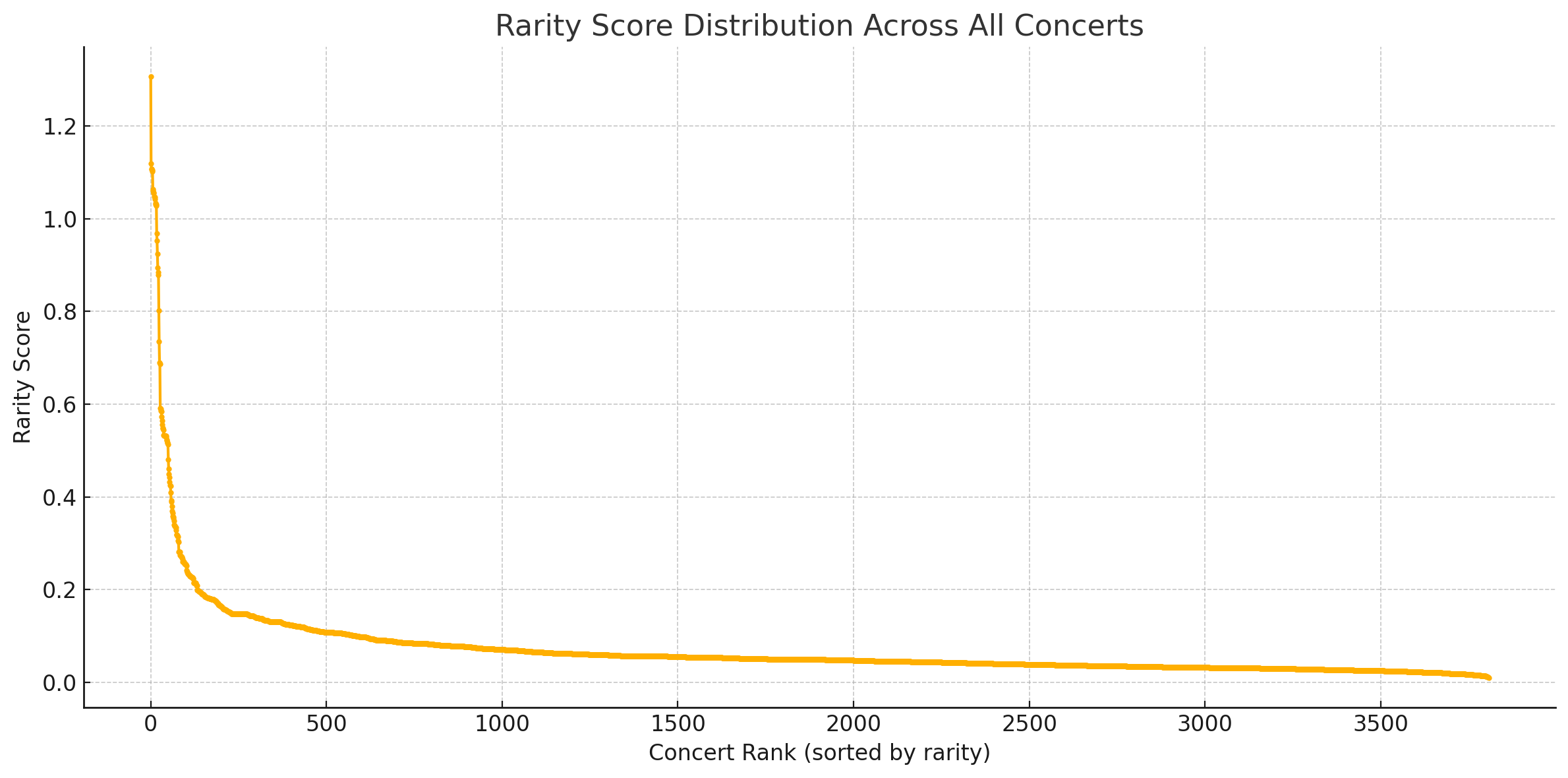
The final concert of the Rolling Thunder Revue, May 25, 1976, in Salt Lake City, Utah, has a rarity score of 1.3062. This high score is largely due to "Lily, Rosemary and the Jack of Hearts", which has a global play count of 1, contributing a full 1.0 to the score.
Other songs like "Shelter from the Storm" (played 25 times) contribute 0.04, while frequently played tracks like "Isis" (100+ plays) contribute much smaller amounts (0.01 or less).
Visualizing Rarity
The chart below (featured in our Salt Lake City analysis) demonstrates how the top 20 Rolling Thunder concerts rank by rarity score.
Why It Matters
Rarity scores provide a data-driven way to highlight historically unique shows. Concerts like Salt Lake City 5/25/76 aren’t just rare because of mythology — they are rare in the math itself.